One common New Year’s Resolution is to to lose weight or change something in your body shape in a definite way. Humans are like the Earth – we have cycles, we need cycles. And, we need markers to timing those cycles. So, celebrating the beginning of a new year is a very important marker that gives us the sense of renovation, renewal, which means that we accept the reproduction or continuity of life but we also hope for something new and better.
In a society immersed in a Diet Culture, the beginning of a new year also highlights the conflicting relationship we have with food, because food is an inherent part of the celebrations and rituals of this time of the year while plays an important role in our body weight and health. Diet Culture includes the mainstream and sometimes medical discourses about weight control, and it spreads some myths about how we can individually control our eating habits and consequently our weight. Most mainstream diets don’t take into consideration all the complexities involved in the definition of a person’s body weight and shape, and in the cultural relationships between emotions and food. So, at the end of the year, when there is this hope for better days, there is a very powerful appeal for you to evaluate your body “imperfections” and to make a decision about them. Behind this appeal there’s also judgment and punishment, because, if we part from the idea that you individually can control your body weight and shape if you don’t, what does this imply about yourself? The emotional effects that come from this implication are terrible and create another cycle – one that is not part of our natural cycles, but part of a collective mental health issue.
Strawberry Tea Set (1912) by Frederick Childe Hassam
Emotional Eating is a term that we use in clinical settings to evaluate how a client’s eating behaviour is triggered by specific emotional needs and/or is responding to those. It is not a disorder and it is not a symptom of a mental health disorder, but it can be part of a mental health assessment. The way we eat can give us some clues about our emotional needs. And, emotional needs that are dysregulated and/or invalidated are in the basis of many mental health disorders. This means that emotional eating is simply part of life, but sometimes it is an indicative that something in our mental health is not well. An example is restricting yourself for an entire day in order to fulfil the anxiety provoked by an extreme negative body-image, and then binge eating at night or a few days later after realizing that starving didn’t make you lose the weight you wanted, feeling angry and a deep urge to self-punish. This kind of cycle reveals how very difficult emotions such as anxiety with body-image and guilt for not loosing weight are being addressed by an eating behaviour.
However, Emotional Eating is just a fact of life and cannot be eliminated! Celebrating with big dinners and gathering people around the table is the main mark of the Holidays at the end of December, which also usually includes drinking more alcohol and consuming more caloric, sugary meals. These meals are part of the joy, lightness, and abundance that we love to share at this time. For many cultures, independent of religion, cooking elaborate, beautiful and delicious meals and serving in abundance for a family and friends gathering mean the recognition of good fortune in life, which means that we are grateful for being alive and blessed by the goods of Earth – and as a Brazilian with a strong Portuguese heritage, I can definitely confirm that as a fact in Latin cultures including the North and South hemispheres. So, what I would like for you to take from this article is a sense of self-acceptance and self-compassion in facing the appeals of the Diet Culture. There’s much more in between our bodies and food than you can control by yourself. This doesn’t mean that you cannot make a decision to change your eating habits, maybe you do need to improve the quality of your meals or you need to address some of you emotional eating. Still, you can do this from a more realistic perspective and accepting your limitations and your possibilities.
It is great that WHO and many countries are finally doing surveys and presenting data on mental health during the covid-19 pandemic. Canada is one of those countries and has a history of accompanying its population’s mental health through regular surveys for the past 40 years. In general, they show that moderate to severe anxiety, depression and post-traumatic stress disorders have increased significantly in 2021 and 2020 compared to precedent years. The issues are not only related to the fear of getting sick but also to economic vulnerability and social isolation.
I know that the pandemic has imposed a burden on all of us, and the illness rates are significantly worse among the elderly. But, regarding mental health, youth, including adolescents, has been the most affected age group. And this has also affected parents’ wellbeing. Recent data shows a probable correlation between parents’ and teenagers’ mental health in the pandemic.
Near the Lake (1879–1890) by Pierre-Auguste Renoir
For the first time, Canadian surveys are showing that having children did not protect adults from suicide ideation. In fact, in 2021, 9% of parents of under 18 kids reported thinking about suicide recently, while 9% of kids under 18 reported the same, against the 6% of the general population, according to the survey conducted by the Canadian Mental Health Association and the University of British Columbia. The exception is indigenous and LGBTQI youth, among whom the rate of suicide thinking came to 15 to 17%. There is no data about parents of LGBTQI teenagers but we can imagine how the burden of dealing with gender and sexual discrimination can add to the pandemic-related issues. In the same survey, more than 20% of parents reported having more conflicts with their children and 11 to 17% reported having increased verbal violence against them.
CMHA has been warning that the decline in children and adolescents’ mental health is an ongoing crisis in Canada since before the pandemic, but it clearly worsened in 2020. For the first time, more than 50% of teenagers reported feeling more anxious. Also, 45% reported a decline in their mental health when in the last survey 36% did. Even though, families are having more quality time together, according to 66% of respondents including parents and children. It seems that parents are more aware of their kids’ mental health decline and are trying to communicate with them and participate in their lives.
But according to The Mental Health Commission Survey, in 2021, most individuals at age 15 to 30 don’t feel comfortable accessing support or help services for mental issues. They feel confident about where to find resources for their wellbeing and mental health; they usually go to the Internet to find those resources, but cannot have proper access to professional help. Only 2% of youth with mental health diagnoses have had access to in-person services and 14% to online services in 2021, according to the mentioned survey. So it seems that while mental health awareness has become more popular on the Internet, it has not been accompanied by better access to adequate services.
While parents can be more informed online on how to help their children, there are issues with which they need help themselves. For instance, usually guidelines suggest parents to control children’s screen time more often. However, with online school and lockdowns, how can parents prevent their kids to spend most part of the day among screens? Also, knowing that youth are seeking mental health resources online how to prevent them to access their devices any time they need? So families are having a hard time establishing boundaries and at the same time validate their children’s need for social connection.
It seems that although families and adolescents are doing important efforts to cope with the pandemic, there is a big gap regarding access to professional services. According to the WHO survey, more than 70% of the countries interrupted mental health services for children and adolescents during the pandemic and 75% interrupted those services in schools and workplaces. To me, it seems that the lack of support from organizations and governments combined with more frequent and intense contact with their children’s suffering has put parents under higher vulnerability. Most of them are trying to help their kids while coping with their own concerns about economic instability and health.
In Brazil, 45% of adults from 18 to 92 years of age presented the criterion for Post-Traumatic Stress Disorder in 2020, according to a survey conducted by the Ministry of Health, and 85% have experienced moderate to high levels of anxiety. We don’t have data about suicide ideation for this country or about specific ages. But we can say that feeling high levels of anxiety and having depressive symptoms during a pandemic as this one is normal – it is coherent with the reality we’re sharing. Accepting this reality while not losing hope is a hard task to perform. For kids who are in the process of learning how to validate and express their emotions, it can be even harder.
When parents watch their kids suffering while also trying to cope with their own mental health issues, sometimes they find a hard time validating and normalizing their feelings and jump to work on problem-solving. Their intentions are good. But the excessive or precipitated focus on problem-solving when someone is in an acute crisis and adequate services are not available can send the opposite message parents are trying to communicate to their children, because it can be felt as invalidating. This is a classical communication problem. And maybe that’s one of the explanations for the increase in verbal violence at homes during the pandemic.
What I propose to families at this point is to avoid toxic positivity. This means to take some time to accept and validate your own struggles giving this challenging context. And it also means to offer solutions to your children in a compassionate way, being aware of their limits and needs. Acceptance of our limits and vulnerabilities does not mean to stop advocating for better mental health and well-being, on the contrary. Do not stop advocating for better and sustainable mental health services and community-based solutions for families and youth. When you communicate with peers and take into account your community’s struggles, you feel less lonely and open ways to creativity and solidarity.
Recently, I read Dr. Marsha Linehan’s autobiography, in which she tells how her personal journey led to the creation of Dialectical Behavior Therapy (BDT) as an effective treatment for a variety of conditions including chronic suicidal behaviours. I loved the book and strongly recommend it to mental health professionals and clients. Reading it I had the feeling of being part of that selected audience who attended her first speech about her own experiences as a mental health patient having been committed to a psychiatric institution during her last adolescent years. On that occasion, in 2011, she was already a renowned professor and behaviour scientist and went public with her testimony to contribute even more to her patients’ and students’ hope in building lives worth living.
Head of Buddha (1943) print in high resolution by Reijer Stolk
DBT is the first evidence-based treatment for highly suicidal individuals, including adolescents. It started in the 1990s as an experimental alternative for women diagnosed with Borderline Personality Disorder (BPD) and has expanded to attend a variety of clients since then, always followed by robust research. Today the training in DBT emotional skills, which is part of the standard treatment, has been taught to people who are not mental health patients, including at schools, to enhance emotional well-being and prevent chronic emotional dysregulation among children.
DBT is known as a type of Cognitive Behavioral Therapy (CBT). But the funny thing is that, in her biography, Marsha admitted her insistence with her first book’s publisher to not label the therapy under CBT umbrella.
The publisher of the book had said the title should include the phrase ‘cognitive behavioral therapy’. I said ‘absolutely not. We are not doing cognitive behavioral therapy; DBT is something different’ (…) In the end, we compromised and called it Cognitive-Behavioral Treatment of Borderline Personality Disorder.
(p. 312)
She explains that DBT is actually rooted in a mix of influences such as Person-Centred Therapy by Carl Rogers -she actually calls him “one of my heroes”, Zen Buddhism, Behavioral analysis and Emotion-focused techniques. Dialectics is the core principle -and yes, the concept was inspired in the Marxist philosophy. In the context of DBT, dialectics means a constant effort to find the sense of opposed stances and synthesize opposed poles, such as acceptance and change, willingness and willfulness, emotions and reasoning.
To develop the complex and effective formula of DBT, Marsha and her team studied and experimented with different theories and techniques such as T-groups from Social Psychology and helplines based on humanistic psychology. They were very pragmatic, focused on what worked independently of any institutional or political polarization at the Academic level. In the end, DBT standard treatment was established as a complete program composed of group works for emotional skills training, individual therapy, phone coaching for preventing crises and consultation teams for the therapists.
But of course, Marsha’s academic journey was not easy. After leaving the psychiatric ward, she went back to night school before getting accepted into university. At the time when she started her Ph.D., psychoanalysis dominated inpatient programs with individuals who had attempted suicide and/or engaged in self-harm, and few pieces of research with that population were carried in completely separated settings mostly by a sociological perspective. Marsha was not involved in a clinical Ph.D., contrary to the pathway of the majority of clinicians who would later work at hospitals and outpatient services. She wanted to do scientific research in order to understand why existent interventions for that population did not work as expected. So she was enrolled in research programs focused on behaviour analysis, and then looked for partnerships and grants to be able to test her developing treatment within mental health services. With DBT, she not only synthesized extreme conceptual poles but also approached radically separated environments.
In her biography, Marsha tells us about her confrontations with the most established psychiatrists and psychoanalysts of that time who were references for the treatment of Borderline Personality at hospitals and had important positions in funding boards. Important to mention that all of them were male assisting a large majority of female patients categorized as having “anger issues”. Her friend Charlie Swenson contributed in Marsha’s book telling one of those confrontations in which he was present:
Then Bob Michaels said ‘look how much you are making out of such little data.’ Marsha shot back, ‘And how much data are there in psychoanalytical treatments of patients at this point?’ (…) They treated her that way because they saw she was really good. You don’t get that unless they feel challenged.
(p. 303)
So, after reading Marsha’s book, I’ve got inspired to reflect on my own encounter with DBT. Because it was not a usual one. I was not a Cognitive Behavioral Therapist as the majority of Brazilian DBT therapists are. I work by a psychosocial approach and by an existentialist-phenomenological approach. Still, before assuming myself as a clinician, all I wanted to do was to be a scientist in the field of social psychology and gender studies.
But I fell in love with DBT because of a couple of young female patients who were diagnosed with Borderline Personality Disorder and had tried different therapies and medications before meeting me in 2015 and 2016. They were particularly ostracised by the mental health system in Brazil and came to me because of my writings on Feminist Psychology. I was not an experienced clinician; actually, I was working hard to finish my Ph.D. and launch my career as a university professor at the Department of Social Psychology at the same university where I had graduated as a psychologist. But I saw women suffering so much and I could not help them if I stayed only in my academic role, criticizing the psychiatric system.
I took a pragmatic way and didn’t care if CBT in my context was considered an individualistic approach not fitted to a population with so many social inequalities. In Brazilian academic settings, psychology theories became so polarized that many of my professors did not even compliment their peers from different theoretical approaches. For many years, CBT was considered anathema among psychologists working with disadvantaged populations. Public mental health centres worked primarily by psychoanalytical and/or psychosocial approaches, even if they cannot offer much to BPD patients and people suffering from suicide ideation and self-harm.
However, while teaching, writing my thesis and working with my private office, I started studying everything that could help me to help those women. That’s when I found Marsha’s papers and realized how her biosocial theory of Borderline Personality Disorder articulated very well with the Feminist Psychology and Phenomenology I was working on within my research. In DBT Emotional Skills Handouts for therapists, Marsha actually states that the treatment comes from a feminist perspective. Also, according to her biosocial theory, biological vulnerability to psychopathologies combined with systemic invalidation during the development is the main cause of high emotional dysregulation. Emotional dysregulation is the inability to experience and cope with intense or difficult emotions in a healthy manner. Different problematic behaviours can occur when the individual tries to avoid or eliminate those emotions, including self-destructive and compulsive behaviours. High levels of emotional dysregulation sustained for a long time or combined with traumatic events can prompt BPD.
Therefore, an alternative explanation to BPD among women would be that girls under repetitive invalidations of their emotional expressions and desires because of gender stereotypes and oppression are at greater risk to develop the disorder. This reminds me of Iris Marion-Young’s phenomenological essays on girls’ corporeal experiences under patriarchal culture. Marsha herself tells us in her biography how she was an atypical outspoken girl in her family and city and how she felt constantly invalidated by her parents.
For my patients with Borderline Personality, this approach also helps a lot to deconstruct the myth of them being the sole cause of their behaviours and suffering. Many times, they come with a history of hearing how they ruined their families because of their compulsive self-destructive behaviours. So, it changes immensely the perspective when the therapist is aware of the function of systemic invalidation based on gender and other stereotypes and can include environmental changes into the patient’s treatment, such as educating parents and communicating with schools.
Feminist Psychology is not only for girls and women. It is a source of constant reflection on the power imbalances that permeates our practices as mental health professionals. Being aware of our role in systematic emotional invalidation of any individual or group is a core principle of it. DBT opened the way to the voices of the most invalidated and oppressed clients of the mental health system.
Aceitação Radical é uma habilidade emocional aprendida na Terapia Comportamental Dialética mas também é um princípio importante no zen budismo e em práticas meditativas. Significa se conectar com a realidade presente sem pretender controlá-la, mas com a intenção de aceitá-la apenas como é. Porém, do contrário que muita gente imagina antes de entrar em contato com a terapia, nem meditação nem aceitação radical são experiências fáceis e relaxantes. Elas até tem um efeito muito positivo em nosso estado emocional, e podem sim ter um efeito de relaxamento no longo prazo. Mas praticá-las pode ser um grande desafio.
Diante de realidades difíceis e em meio a tantos estímulos ansiogênicos é ainda mais desafiador praticar aceitação e cultivar um estado emocional em atenção plena. A tendência é embarcar na ansiedade e responder fugindo da ameaça, ainda mais se for uma ameaça “invisível”. E é por isso que, em meio a pandemia da covid-19, observamos tanta gente lutando contra a realidade e agindo de formas bastante contraditórias aos valores que elas mesmas prezam (levando em consideração aquelas pessoas que prezam pela vida).
Série Introspectiva, Jialu Pombo (2009)
Um exemplo básico de como funciona a Aceitação Radical é em casos de transtornos mentais onde a ansiedade tem um papel preponderante. Essa habilidade previne aquele medo de sentir medo ou a ansiedade como resposta à crise de ansiedade, que geram um ciclo vicioso. Num quadro mais depressivo, por exemplo, acontece mais ou menos assim: eu sinto os primeiros sinais físicos da ansiedade, então penso que “lá vem uma crise”, me julgo por mais uma vez estar tendo uma crise, fico com raiva de mim mesma, me alieno de meus valores de amor próprio, me sinto mais vulnerável, a ansiedade aumenta, as crises pioram… Num quadro com abuso de substâncias, posso acabar respondendo ao sentimento de vulnerabilidade com um comportamento compensatório, usando alguma droga que me dê maior sensação de poder. Mas, praticando a Aceitação Radical, eu passo a entender melhor a realidade da minha saúde mental e a aceitar que ela inclui crises de ansiedade. Então, numa situação de crise, ao perceber os sintomas físicos mencionados, eu aceito que eles fazem parte dessa realidade, aceito que tenho um problema de saúde, aceito as soluções válidas para esse problema e valido o fato de já estar agindo para melhorar, então ao invés de me julgar, me alienar de meu amor-próprio, ficar mais ansiosa, reconheço meu esforço e me comprometo ainda mais com um tratamento eficaz.
O desafio está naquele momento em que a ansiedade não está exatamente ativa, em que eu estou relativamente bem, na segurança do meu lar, e decido parar para meditar na realidade do momento presente e aceitá-la radicalmente. Um dos exercícios propostos para o desenvolvimento da habilidade da Aceitação Radical é descrever realidades que eu tenho muita dificuldade em aceitar, assumindo uma postura disposta e não julgadora. Então, na minha meditação, eu me dou conta de um medo lá no fundo da minha mente: o medo da pandemia. Eu descrevo a realidade dessa pandemia da forma mais esclarecida e realista possível. Eu entendo que muitas pessoas já morreram dessa doença. Entendo o meu lugar nessa realidade. Aceito que há muitas variáveis que não posso mudar, e algumas com as quais posso colaborar. Mas ao longo desse processo, eu percebo meus medos, meu sentimento de impotência, minha raiva, minha vontade de fugir dessa realidade. Então, é difícil de aceitar. E mesmo assim, eu decido aceitar.
Algumas coisas só mudam na mente depois de mudarmos os comportamentos. Agir envolve muito mais de nosso corpo do que só pensar. Praticar Aceitação Radical envolve então não só a descrição das realidades difíceis, mas o engajamento em comportamentos coerentes com a realidade mesmo que eu esteja lutando internamente com ela. Eu sei que usar máscaras, cuidar delas, carregá-las para todo lugar que eu tiver que ir vai me lembrar do medo da pandemia, e eu honestamente preferia esquecê-la… Mas, eu decidi aceitar a realidade de forma radical, porque eu sei que isso é melhor para mim e é mais coerente com meus valores pessoais, como o valor da defesa da vida. Então, eu uso a máscara, mesmo contrariando aquela ansiedade que me manda fugir. O mesmo acontece com comportamento de distanciamento social. E cada vez que eu repetir esses comportamentos, a contrariedade vai diminuir. E eu vou me sentir validada e fortalecida na minha decisão.
É claro que se eu me engajar nesses comportamentos mais saudáveis mas me sentir julgada pelos outros ou sentir que estou muito sozinha nesse esforço, minha disposição em continuar coerente com a realidade vai ser desafiada. Agora, além da ameaça da pandemia, eu sinto a ameaça da solidão. E essas realidades vão entrar em conflito com meus valores. Então, num contexto de pandemia como esse, é compreensível que as pessoas oscilem tanto, às vezes se alienem, se percam de suas intenções, fujam. Mas, para quem não desistiu e pra quem desistiu mas ainda tem uma dissonância cognitiva aí, eu convido a buscar validação e apoio entre aqueles que permanecem insistentes na prática da aceitação. Vem comigo!
O Transtorno de Personalidade Borderline (TPB), assim como todo transtorno de personalidade, pode ser melhor compreendido por uma explicação biossocial, que inclui fatores genéticos e sociais do desenvolvimento psicológico. Podemos dizer que o TPB é uma evolução patológica de um perfil de personalidade que inclui maior sensibilidade emocional e maior vulnerabilidade à traumas psicológicos ao longo da infância e adolescência. Da minha perspectiva, nem todas as pessoas com características limítrofes da personalidade desenvolvem o transtorno. Mas é importante reconhecer que elas apresentam um risco mais elevado de desenvolvê-lo.
Kamisaka Sekka, 1909
O TPB afeta profundamente a organização dos sentidos e a regulação emocional, produzindo experiências de vazio profundo, de “não existir”, às vezes de “estar fora do próprio corpo”, com pensamentos acelerados e muita dificuldade de identificar e nomear os sentimentos. Esse sintomas aparecem geralmente diante de gatilhos que podem ser diferentes para cada pessoa mas que em geral são fontes de forte invalidação.
Na infância e na adolescência, aquela vulnerabilidade genética se expressa por respostas desproporcionais à eventos desagradáveis ou altamente excitantes. Crises de intensa desregulação emocional podem até provocar comportamentos de autolesão e de agressividade contra os outros. A princípio esses comportamentos são respostas impulsivas à toda essa sobrecarga emocional e sensorial, e podem se tornar crônicos. Quando os cuidadores não são capazes de oferecer validação e ensinar estratégias de expressão emocional mais saudáveis, a culpa e o autojulgamento se intensificam, provocando mais experiências disruptivas. O conjunto dessas variáveis, repetindo-se de forma sistemática, levam o transtorno a se instalar no início da vida adulta com um aumento considerável do risco de suicídio.
Fundamentalmente, o TPB afeta o contorno subjetivo que a maioria das pessoas parece desenvolver naturalmente. Isso ocorre porque são as sensações físicas e suas correspondentes emocionais que contribuem para a integração da experiência humana de um “Eu” relativamente estável no tempo e no espaço. Então os limites nas relações com familiares, amigos e parceiros sexuais também se tornam instáveis e frágeis. Há um alto risco dessas pessoas se engajarem em relacionamentos destrutivos, às vezes se tornando vítimas de relações abusivas, às vezes sendo abusivas com seus parceiros. O abuso de substâncias psicoativas pode acabar se tornando uma resposta autodestrutiva para a dor emocional causada pelo transtorno.
Mas a personalidade limítrofe ou borderline também pode ser vista por suas potencialidades. Em geral, crianças e adolescentes com traços dessa personalidade são mais sensíveis emocionalmente, incluindo maior sensibilidade sensorial e estética, então são muito criativos e empáticos. São capazes de oferecer pontos de vista inovadores. Muitas vezes, na adolescência, tem uma sexualidade mais livre e fluida, são menos influenciáveis por preconceitos e podem ser amigos leais, capazes de compreender aquilo que poucos compreendem. Mas, por não se limitarem a certos tabus sociais, podem ser mais submetidos a constante invalidação por adultos e colegas, e podem acabar expressando desconexão ou indiferença como autodefesa.
Não é coincidência que na vida adulta, muitos indivíduos com TPB se dedicam a carreiras criativas, como artes, gastronomia, música, pesquisa, e se destacam pelo que fazem. A artista brasileira Lygia Clark ficou conhecida pelas intervenções artísticas que criou com pessoas consideradas border nos anos 1970 e 1980. As experências dessas pessoas com dispositivos artísticos inspirou a artista a criar objetos e performances interativas que potencializam as experiências estéticas de quem participa.
A cientista e psicóloga Marsha Linehan desenvolveu o tratamento mais eficaz para o transtorno com o qual foi diagnosticada no início da vida adulta, e hoje é reconhecida internacionalmente. Em sua recente autobiografia, ela conta como era conhecida por ser uma adolescente autêntica, com uma busca peculiar pelo desenvolvimento espiritual e ao mesmo tempo um comportamento atípico para as meninas de sua época e contexto social. As constantes invalidações que ela sofreu por parte de seus pais e instituições psiquiátricas levou-a a experimentar os piores sintomas do transtorno. Mas, ao encontrar recursos para sobreviver às crises, voltou a estudar, se encontrou no budismo zen, e se dedicou intensamente a pesquisar e assistir pessoas parasuicídas.
Não existe remédio para TPB. O tratamento mais eficaz, baseado em evidências científicas é a psicoterapia com abordagem comportamental-dialética desenvolvida por Linehan, em inglês Dialectical Behavior Therapy (DBT). Essa terapia se baseia em aceitação e mudança como forças dialéticas. Na minha experiência como psicoterapeuta de adolescentes em risco de TPB e jovens com diagnóstico de TPB, tenho tido a felicidade de ver excelentes resultados! Formada em DBT e com um olhar culturalmente sensível, trabalho com o tripé: acolhimento, aceitação e transformação. A participação da família buscando mudar o padrão de comunicação invalidante também ajuda muito. O DSM V sugere que além de psicoterapia, o engajamento da/o paciente numa atividade produtiva, a atividade física e a relação com animais de suporte emocional também contribuem para a total recuperação.
A grande maioria das pessoas com TPB que recebe tratamento no início da vida adulta tem uma melhora imediata na qualidade de vida e entra em remissão total depois em cerca de 10 anos do diagnóstico. E essa remissão não significa supressão das potencialidades da personalidade. Pelo contrário, aceitar e validar essas potencialidades é parte do tratamento. E por isso precisamos de sociedades mais acolhedoras às diferentes formas de expressão subjetiva. A Personalidade Borderline nos faz pensar na plasticidade do desenvolvimento humano. A pessoa humana é capaz de sentir as sensações mais desorganizadoras, mas, também é capaz das experiências mais transformadoras de transcendência, de amor profundo, cumplicidade e conexão plena.
For the purpose of comprehension, in this text, I’m calling animals the non-human ones. Also, I am not using emotional-support animals as the term designated by law and regulations. I find this expression interesting if regarded in a broader sense since researches have shown how bonding among humans and animals presents a strong emotional aspect, independently of specific psychological needs.
Greyhound (1912) by Moriz Jung
The first time I saw the expression emotional-support animal in a psychological context was from one of my students at the Federal University of Rio de Janeiro, during a class on Group Dynamics and Human Relationships. I had already read about Equine-therapy, especially for children in the autistic spectrum, and I was aware of the benefits of bonding with animals for them and also for neurotypical children. Many parents get pieces of advice from Mental Health Professionals or Educators about the advantages of adopting a pet for their children at some stage of their development. I had also learned about people recovering from addiction and parasuicide behaviours adopting animals in the process and learning how to take responsibility for others and improving responsibility for own-selves. But I’ve found it pretty interesting a student suggesting to work on emotional-support animals for her final assignment in a class on Human Relationships.
We were discussing at that class different group-therapies and groupworks for different types of clients. Students were interested in groupworks by psychodrama approach, cognitive-behaviour groups for eating disorders patients, T-groups in workplaces etc, and this specific student wanted to talk about her internship at an LTC facility in which a volunteer started to take sheltered cats and dogs to interact with a group of residents on a weekly basis. The psychologist at the facility developed a program for the residents with dementia and realized how their interaction with the pets improved their relationships in general. It seemed that their memories were stimulated from a very emotional trigger – their own relationships with animals during their childhood or adulthood before being institutionalized. Memory is glued with emotion.
Then, supervising that student gave me the opportunity to reflect on something that was already part of my observations as a therapist at the time. Many of my clients lived with animals at their homes. While some of them had adopted the animals themselves others had to cohabit with their parents, partners, siblings’ pets. Anyways, it became clearer for me how those sometimes almost forgotten presences required some degree of willingness from their human fellows. Willingness is an important therapeutic skill. It’s the ability to be open and responsive to reality. I could also observe how teenagers and young adults with high levels of emotional dysregulation were more prone to self-regulate when willing to respond to their pets’ needs. Although you cannot always predict your pet’s behaviours and needs, their variability is usually under the scope of your capacity to respond.
At the same time, the animals provided sensations and interactions that built daily stability for my clients. The relatively small amount but constant emotional stimuli from the relationship with their pets fostered the basis for emotional regulation and could help them to cope with disruptions. If it can be hard to express your emotions and feelings in words to another human being, for some reason, sometimes it seems so easy to be understood by a close dog, cat, horse, bird, etc. The relationship with animals has the potential to be very validating because you feel capable of taking care of them at the same time you can be understood on a deep level with no words. Among others, two aspects are crucial in our mental well-being: stability and adaptability, which form a basic dialectic duo. Animals can surely contribute to that.
Reference:
Fragoso Pereira, Mara Julia, Pereira, Luzinete, Lamano Ferreira, Maurício Os benefícios da Terapia Assistida por Animais: uma revisão bibliográfica. Saúde Coletiva [en linea]. 2007, 4(14), 62-66 https://www.redalyc.org/articulo.oa?id=84201407
Therapeutic Presence is the private practice of Carolina Pombo, Ph.D., M.Sc. and Registered Psychotherapist (Qualifying). It is located in Burlington North and offers in-person, indoor and outdoor appointments or virtual appointments. You can contact Carolina directly by our Contact Form or Psychology Today page.
You can navigate through the menu bar to find more information about our services, therapeutic approaches, and events, and to read some of Carolina’s articles in English, Portuguese and French.
Cette année a été particulièrement difficile pour les personnes atteintes de maladies chroniques. Ce sont des maladies qui ne représentent pas un risque immédiat pour la vie, mais qui entraînent des dommages importants dans la vie quotidienne et peuvent entraîner la mort à moyen et long terme. Je fais référence, par exemple, aux maladies auto-immunes et aux troubles de santé mentale chroniques – des conditions très sensibles au stress et qui ont un impact énorme sur l’autonomie individuelle.
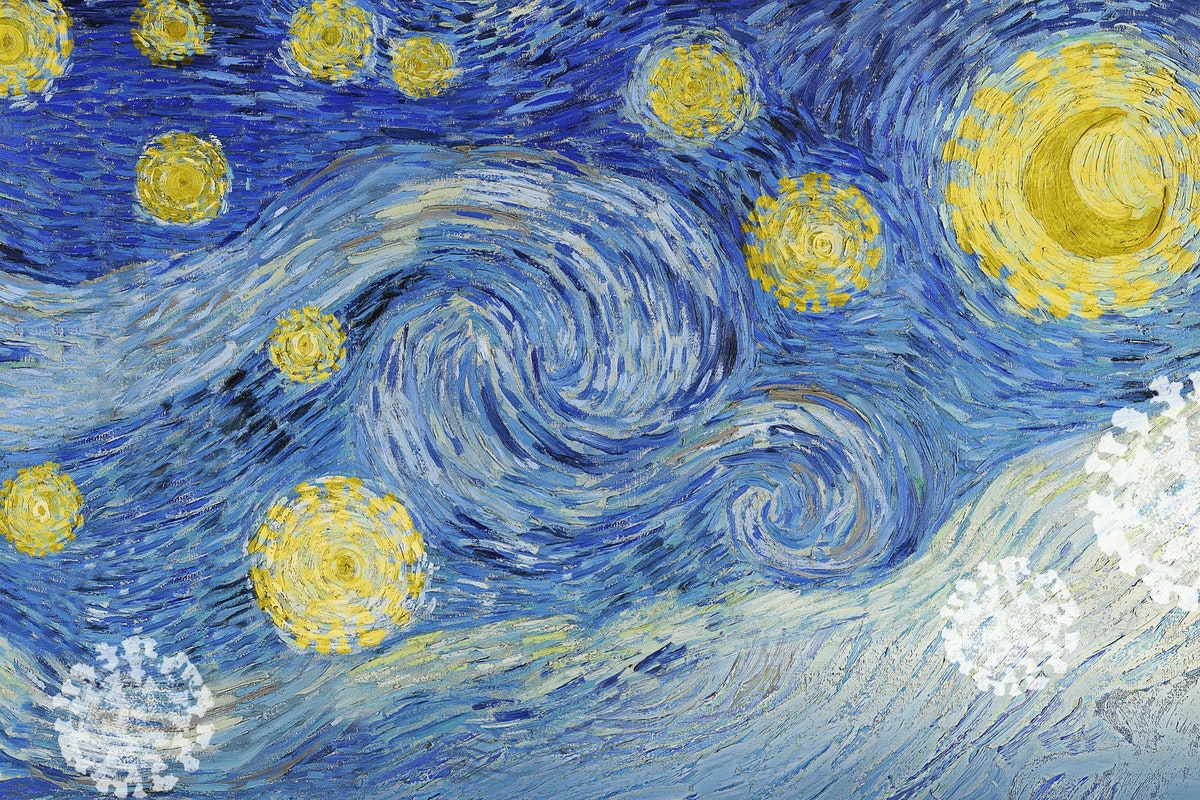
Van Gogh’s The Starry Night coronavirus pandemic remix
En 2020, Covid-19 est venu sous les projecteurs, non seulement en raison de son ampleur – comment ne pas se concentrer sur une pandémie ? Mais pour ses taux de mortalité élevés. Ainsi, le sujet le plus ciblé par les établissements de santé en 2020 a été une maladie aiguë, ce qui peut avoir pour effet secondaire de réduire l’intérêt général pour les maladies chronique. C’est vrai qu’en mettant l’accent sur Covid-19, nous avons redoublé le regard sur certaines maladies chroniques telles que l’hypertension artérielle et le diabète, parce qu’elles augmentent la vulnérabilité aux pires formes de l’infection. Mais qu’avons-nous appris sur les patients souffrant de problèmes de santé mentale et d’autres diagnostics qui ne sont pas directement associés à la pandémie ?
En 2020, les personnes atteintes de maladies chroniques ont dû faire face non seulement aux risques de covid-19, mais également au niveau de stress élevé qui l’accompagnait et à l’accès limité aux traitements. Les cabinets privés et les centres de santé fonctionnent de manière très limitée ; les physiothérapies, les hydrothérapies, les thérapies complémentaires de tous types ont été disponibles de manière restreinte ou n’ont pas été disponibles du tout. Il en va de même pour les services de base qui contribuent de manière significative au bien-être de ces personnes, tels que les installations de loisirs, les gymnases, les marchés ouverts, les temples, etc. Pour de nombreuses personnes, l’obstacle à l’accès à ces services signifie plus d’inflammation, de douleur, d’anxiété et plus dommages généraux. Comment entrer en 2021 après cette expérience extrêmement difficile ?
Je crois que les appels des gouvernements et des professionnels de la santé pour que chaque personne jeu son rôle dans cette pandémie peuvent être étendus à d’autres problèmes de santé également. Car, en réalité, toutes les maladies sont partiellement déterminées par le contexte social, ce qui signifie que chaque personne peut aussi jouer un rôle pertinent dans la réadaptation d’autrui souffrant de maladies chroniques. Par exemple, ce n’est pas seulement la psychothérapeute qui peut aider une personne souffrant de dépression, mais l’ensemble du réseau d’amis, de famille, des voisins … Même nos valeurs culturelles peuvent avoir un impact sur les résultats de la dépression. Alors, la première leçon importante que 2020 nous a donnée est sur le rôle crucial de la solidarité ou, en d’autres termes, de la responsabilité pour autrui, et pour la santé collective.
Je pense qu’en 2021, nous devrons faire preuve d’encore plus d’empathie, d’attention et de responsabilité envers nos proches, en particulier les plus vulnérables ; et nous pouvons tirer profit de cette expérience de la pandémie pour améliorer cela. Une attitude importante à cet égard est de reconnaître les privilèges et le potentiel d’aide. Cela signifie que nous devons assumer notre pouvoir d’aider les autres. On sait, par exemple, que les enfants et les adolescents atteints de maladies chroniques dépendent fortement des adultes pour faire face à leurs symptômes et recevoir des traitements. On sait également que les femmes souffrent d’un fardeau mondial plus élevé de maladies chroniques que les hommes et que ces derniers ont tendance à souffrir davantage d’accidents et de violence et sont moins disposés à prévenir les maladies. C’est des informations statistiques. Mais, en réalité, chaque famille a ses particularités, chaque quartier, sa dynamique. Et chacun sait ou a l’opportunité de savoir quel rôle jouer dans la santé de ses proches.
Par exemple, si vous êtes parent d’un adolescent présentant des symptômes de santé mentale, tels que l’alcoolisme et une dérégulation émotionnelle intense, vous avez peut-être joué un rôle encore plus crucial dans sa récupération en 2020, et votre présence aimante et disponible tout au long de 2021 va continuer à être indispensable. Si vous êtes marié à une personne atteinte d’une maladie rhumatologique qui souffre avec une mobilité réduite, vous avez été encore plus proche de sa souffrance en 2020, et probablement votre aider à soulager ses symptômes en 2021 va continuer à être importante.
Une autre leçon peut également être tirée de tout ça : si vous avez vous-même l’une de ces maladies chroniques, peut-être avez-vous essayé des moyens de surcompenser vos limites en 2020, peut-être même en niant vos limites physiques et émotionnelles et en vous soumettant à des situations plus risquées. Mais maintenant, vous avez la possibilité d’apprendre comment améliorer votre connaissance de soi-même et votre communication en demandant de l’aide. Il est si important de communiquer vos vulnérabilités et de faire davantage confiance à la capacité des autres à vous aider. Après tout, l’autonomie individuelle est le résultat d’un système collectif, de la naissance à la fin de la vie. Et on peut dire la même chose de la santé. Il est sain d’accepter vos symptômes et de savoir comment les nommer, les expliquer et au besoin, demander de l’aide.
En 2021, avec les vaccins, mais toujours avec les mesures nécessaires pour prévenir la covid-19, nous continuerons d’adapter nos systèmes familiaux et sociaux à cette expérience disruptive apportée d’ici 2020. Je vous invite à réfléchir sur votre rôle dans ces systèmes, vos besoins et vos potentialités. Que ce soit une année de consolidation de tout ce que nous avons appris, et qu’elle soit beaucoup plus heureuse !
This year has been especially difficult for those with chronic illnesses. These are diseases that do not represent an immediate risk to life, but bring significant damage to everyday life and can lead to death in the medium and long term. I am referring, for example, to autoimmune diseases and chronic mental health disorders – conditions that are very sensitive to stress and have a huge impact on individual autonomy.
In 2020, Covid-19 came into the spotlight, not only because of its magnitude – how could we not focus on a pandemic? but for its high mortality rates. Thus, the most focused subject by health institutions was an acute illness, which may have the side effect of reducing general interest in the above-mentioned ones. With Covid-19 focused we have learned about some chronic conditions as high blood pressure and diabetes that increase the vulnerability for worst forms of the infection. But what have we learned about patients with mental health issues and other diagnostics that are not directly associated with the pandemic?
Van Gogh’s The Starry Night coronavirus pandemic remix
In 2020, people with chronic illnesses had to deal not only with the risks of covid-19 but also with the high level of stress that came with it and the limited access to treatments. Private offices and health centres have been operating in a very limited way; physiotherapies, hydrotherapies, complementary therapies of all types have been offered in a restricted way or have not been offered at all. The same is true regarding basic services that significantly contribute to the wellbeing of those people, such as recreation facilities, gyms, open markets, temples, etc. For many people, the barrier to access those services means more inflammation, pain, anxiety and more general damage. How to enter 2021 after this intensely hard experience?
I believe that the calls from governments and health professionals for each person to do their part in this pandemic can be extended to other health conditions as well. Because, in reality, all of them are partially determined by social context, which means that each person can play a relevant role in the rehabilitation of others with chronic diseases. For instance, it is not only the therapist who can help an individual with depression but the entire network of friends, family, acquaintances … Even our cultural values can impact depression outcomes. Then, the first important lesson 2020 has given us is the crucial role of solidarity or, in other words, social responsibility, for our health.
I do believe that in 2021, we will need to show even more empathy, care and responsibility towards the ones next to us, especially the most vulnerable ones; and we can gain from this pandemic experience to improve that. One important attitude in this regard is to recognize privileges and the potential to help. This means that we have to take responsibility for our power to help others. It is known, for example, that children and adolescents with chronic illnesses rely heavily on adults to deal with their symptoms and to have treatments. It is also known that women suffer a higher global burden of chronic diseases than men and that the latter tend to suffer more from accidents and violence and are less willing to prevent diseases. Those are statistics insights. But, in reality, each family has its particularities, each neighbourhood its dynamics. And each one knows or has the opportunity to know what role to play in the health of their close ones.
For instance, if you are a parent of a teenager with mental health symptoms, such as alcoholism and intense emotional dysregulation, you may have had an even more crucial role in their rehabilitation in 2020, and you will need to maintain your loving and responsive presence for them throughout 2021. If you are married to someone with a rheumatological disease who is in pain and has reduced mobility, you must have become even closer to their suffering in 2020, and you will need to care and help relieve their symptoms more than you are used to, in 2021.
Another lesson can also be learned: if you yourself have any of those chronic diseases, maybe you have tried some ways to overcompensate your limitations in 2020, perhaps even denying your physical and emotional boundaries and submitting yourself to riskier situations. But now, you have the opportunity to learn how to improve your awareness and communication in asking for help. It is so important to communicate your vulnerabilities and to trust further on the ability of others to help you. After all, individual autonomy is the result of a collective system, from birth to the end of life. And the same can be said about health. It is healthy to accept your symptoms and to know how to name them, explain them and when needed, ask for help.
In 2021, with vaccines, but still with the necessary measures to prevent covid-19, we will continue to adapt our family and social systems to this disruptive experience brought by 2020. I invite you to reflect on your role in these systems, your needs and your potentialities. May it be a year of consolidation of everything we have learned, and may it be much happier!
Este ano de 2020 foi especialmente difícil para quem tem doença crônica. Estou falando de doenças que não representam risco imediato à vida, mas trazem prejuízos significativos para a qualidade de vida no cotidiano e podem levar à morte no médio e longo prazo. Estou falando por exemplo de doenças autoimunes e transtornos mentais – condições que são muito sensíveis a estresse e geram enorme impacto para a autonomia.
Neste ano, o assunto mais focado pelas instituições de saúde foi uma doença aguda, que talvez tenha como efeito colateral a diminuição do interesse geral nas demais condições. A covid-19 ficou sob os holofotes, não só pela sua magnitude – como não focar numa pandemia? Mas pela alta mortalidade.
As pessoas com doenças crônicas tiveram que lidar não apenas com os riscos da covid-19, mas também com o alto nível de estresse que veio junto com ela e com as limitações de tratamentos. Consultórios e ambulatórios tem funcionado de forma bastante limitada; fisioterapias, hidroterapias, terapias complementares de todos os tipos tem sido oferecidas de forma restrita ou não tem sido oferecidas. O mesmo acontece com serviços básicos que contribuem significativamente para a qualidade de vida dessas pessoas, como academias, feiras livres, templos etc. Para muita gente a falta de acesso significa mais dores, mais sintomas, mais ansiedade e mais prejuízos. Como começar o ano de 2021 depois dessa experiência tão difícil?
Van Gogh’s The Starry Night coronavirus pandemic remix
Eu acredito que os apelos de governos e profissionais de saúde para que cada pessoa faça a sua parte nessa pandemia podem ser extendidos às outras condições de saúde. Porque, na realidade, todas elas são parcialmente determinadas pelo contexto social, o que significa que cada pessoa pode ter um papel relevante na reabilitação de outras com doenças crônicas. Isso significa que não é só a terapeuta que pode ajudar a um indivíduo com depressão, por exemplo, mas toda a rede de amigos, familiares, conhecidos… No último nível de relação dessa rede, podemos dizer que os valores culturais que cultivamos podem impactar a saúde de todos.
Mas, focando no nível mais íntimo, eu acredito que em 2021, precisaremos ter ainda mais empatia, cuidado e responsabilidade com nossos próximos, principalmente os mais fragilizados. A primeira atitude importante nesse sentido é a de reconhecer seus privilégios e potencialidades diante dos outros; assumir a responsabilidade que lhe cabe. Sabemos, por exemplo, que crianças e adolescentes com doenças crônicas dependem enormemente dos adultos para lidarem com seus sintomas e tratamentos. Sabemos que mulheres sofrem uma carga global de doenças crônicas mais elevada do que os homens, e que eles tendem a morrer mais em acidentes e situações que envolvem violência. Mas, cada família vive sua situação particular. E cada um sabe ou está tendo a oportunidade de saber que papel deve assumir na saúde de seus familiares.
Se, por exemplo, você é mãe ou pai de um adolescente com sintomas em saúde mental, como alcolismo e intensa desregulação emocional, talvez tenha precisado assumir um papel ainda mais crucial na reabilitação dele em 2020, e vai precisar manter sua presença amorosa e responsável ao longo de 2021. Se você é casado com uma pessoa com doença reumatológica que sente dores e tem sua mobilidade reduzida, deve ter ficado ainda mais próximo do sofrimento dela em 2020, e vai precisar acolher e ajudar a aliviar seus sintomas mais do que está acostumado, em 2021. E se você é portador de alguma dessas doenças, deve ter ensaiado formas de super compensar suas limitações em 2020, talvez até desrespeitando seus limites físicos e emocionais. E agora, está tendo a grande oportunidade de aprender a pedir ajuda, a comunicar suas vulnerabilidades e a dar mais valor capacidade de seus próximos em ajudá-lo. Afinal, a autonomia individual é resultado de uma rede coletiva, desde o nascimento até o final da vida. E podemos dizer que a saúde também.
É saudável aceitar seus sintomas e saber nomeá-los, explicá-los e quando necessário pedir ajuda. Em 2021, com vacinas, mas ainda com as medidas necessárias para prevenir a covid-19, vamos continuar readaptando nossos sistemas familiares e sociais a toda essa experiência disruptiva que foi 2020. Eu o convido a refletir sobre seu papel nesses sistemas, suas necessidades e potencialidades. Que seja um ano de consolidação de tudo que aprendemos, e que seja muito mais feliz!











 Carol Pombo